

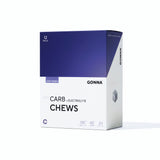
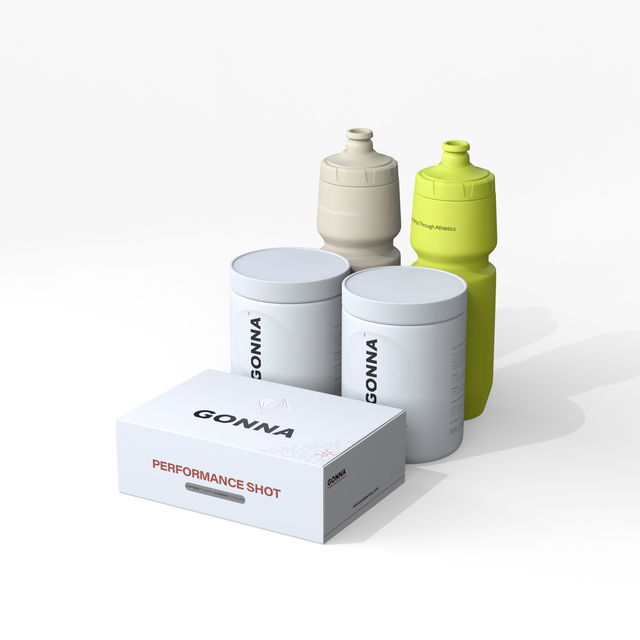
Two and a half years. One chew.
When we said we wanted to make a chew, everyone assumed it was the easy bit. How hard can one little chew be? Turns out, very. It took two and a half years and a lot of batches we'd rather not talk about.
We wanted one thing. A carb you'd genuinely look forward to at hour three, instead of one more thing to choke down. Easy to say. Then you write the list out, and the list starts arguing with itself.
Soft enough to chew without thinking about it. Firm enough to survive a sweaty bib pocket. Can't glue itself to your teeth. No gelatin, because we wanted it vegan, and gelatin is the exact thing that makes most chews chew so well. Gluten-free. Properly loaded with carbs, but not so sweet you're wincing by the third one. And it all has to behave when you're out of breath and your stomach has gone fussy.
Every box you tick knocks another one over. Make it less sticky, you lose the bite. Take out the sweetness, the texture falls apart.

And two things made it properly hard. Most chews are basically pure sugar. We built ours on maltodextrin instead, a carbohydrate that behaves nothing like sugar the moment you try to set it into a chew, but gives you steadier energy and a lot less of that sugary hit. Then we added salt. Sounds like nothing. It argues with almost everything else in the recipe, and getting it in there without wrecking the texture or the taste took longer than we'd care to admit.
That is the puzzle we sat with for two and a half years.
Getting it open (and why there are only six)
A chew is only any use if you can actually get to it. Picture it. Out on the bike or deep into a long run, cold hands, breathing hard, and a wrapper that wants a wrestle. No thanks. So we built the strip to tear open with one hand. No stopping, no teeth, no fishing about in a bag. Pull, chew, carry on.
And we stopped at six. Plenty of brands cram twenty into a pouch, which feels generous right up until it's rattling around your pocket and you've lost count of what you've had. Six is a dose you can actually keep track of. One strip, one job.
Six chews. One clean tear. Sorted.
So we found people who actually know this stuff
We are good at sports nutrition. We are not, it turns out, experts at making chews. So we teamed up with a small, family-run maker here in the Netherlands who have been getting this right for decades. We brought the idea and the key needs. They brought the know-how, and a lot of patience.
Then we just kept going. New gelling system. Tweak the carb ratio. More moisture, less moisture. Flavour up, flavour back. Most batches were not it. A few were genuinely bad. But every bad one pointed straight at the next thing to fix.
How they're actually made (the good bit)
This part still gets us, honestly. It is proper old-school craft.
First, starch. Trays get filled with fine dry starch and smoothed flat, like a tiny field. Then a board stamped with the chew shape presses down and leaves rows of little moulds behind. Hundreds of tiny chew-shaped holes, all ready to fill.
Then the warm mix goes in, poured into every mould one shape at a time. And then you wait.
The trays go into a drying room and sit there for two or three days. The starch slowly pulls the moisture out, and the chew firms up to exactly the bite we'd been chasing. Pull them too early and they slump. Leave them too long and they go tough. There is a sweet spot, and the only way to hit it is time. No shortcut, no button to press.
When they're ready, they come out of the starch, get a quick clean and a light coat so they don't stick together, and the starch is sieved and used all over again.
AND AFTER ALL THAT
One strip, doing one simple job. Six chews. 48g of carbs on a 2:1 ratio, 120mg of sodium, vegan, gluten-free, and a berry hit that's gone in about thirty seconds so you actually want the next one.
Easy to chew. Doesn't stick. Not too sweet. The fuel you still reach for at kilometre 35. That was the whole idea. Funny how much work it takes to make something feel that simple.
Our pricing
Premium fuel shouldn't cost a premium.
Most of what you pay for sports nutrition has nothing to do with what's in the packet. It's everything stacked around it. Distributors, importers, agents, middlemen, each one adding a margin before the product gets anywhere near you. By the time it lands in your hand, a big chunk of the price is just the journey it took to get there.
We built GONNA to skip most of that. We work directly with the suppliers who make our ingredients and our chew, here in the Netherlands and Belgium. No importers, no middle layers stacking margin on margin. What we save by going direct, we put straight back into two things: better ingredients, and a lower price.
That is the real goal. We want GONNA to feel like a premium product, properly made, with ingredients we're genuinely proud of, without the premium price tag. That balance is the hard part. Most brands land at one extreme or the other: cheap and forgettable, or lovely and out of reach. We want both at once, and we're stubborn about it.
It is not a new trick. Some of the best brands of the last decade grew exactly this way, cutting out the middle and handing the saving back to the customer. We're doing the same thing, for fuel.
We take real pride in it. And as we grow, the plan is not to quietly keep the difference. The bigger we get, the better we can buy, the better we can make it, and the more we can hold the price where it should be.
Premium ingredients. A price that makes sense. And a brand you love to show off.
That is the whole idea. But don't take our word for it. Here's what €20 of fuel actually buys you, next to the chews you already know.
How far does €20 fuel you?
A fuel only works if you can afford to use it. Most chews and gels cost so much you ration them to race day, the worst time to be under-fuelled. C.O1 is priced to take at full dose, every session. A hard hour burns roughly 90g of carbs. Drag the slider to see how far €20 actually goes.
GONNA Carb Chew
Best valueHours of fuel
0 strip · 0g carbs
SiS Beta Fuel Chew
Hours of fuel
0 strip · 0g carbs
Clif Bloks
Hours of fuel
0 sleeve · 0g carbs
Precision PF 30 Chew
Hours of fuel
0 pack · 0g carbs
Styrkr GEL50
Hours of fuel
0 gel · 0g carbs
Neversecond C30
Hours of fuel
0 gel · 0g carbs
Maurten Gel 100
Hours of fuel
0 gel · 0g carbs
Cheaper per gram means you fuel every session, not just race day.
Plan your fuelCompetitor data sourced from publicly listed nutrition information and EU retail pricing, 2026. Carbs delivered = floor(budget ÷ unit price) × carbs per unit. Hours of fuel = carbs ÷ 90g/hr (race pace). Prices and availability may vary by region.