
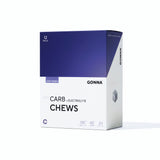
Same absorption, different behaviour. Here is where each one wins, including where gels beat us.

Do energy chews absorb slower than gels?
No. Once carbohydrate reaches your small intestine, your transporters govern absorption, and they do not care whether it arrived as a liquid or a solid. Pfeiffer and colleagues ran gels, drinks and solids head to head across three hours of cycling and found oxidation rates effectively identical.
What actually separates them
| Energy chews | Energy gels | |
|---|---|---|
| Carbs per unit | 48 g per strip (C.O1) | 22 to 40 g per sachet |
| Dosing | Six pieces, take any number | All or nothing once torn |
| Sodium | 120 mg per strip (C.O1) | 0 to 300 mg by brand |
| Above threshold | Chewing competes with breathing | Goes down without effort |
| Packaging | Reseals in a pocket | Leaks, sticky bib |
| Taste at hour four | Holds up | Most people tire of it |
Where chews win
Dosing. Six cubes means you choose how much and when. Three now, three in twenty minutes. A gel gives you one decision and you have already made it.
Mess. Nothing leaks into a jersey pocket. Your bars stay clean and your bib survives.
Wanting it at hour four. Sweetness fatigue changes races. Once fuel turns unpleasant you start rationing, and rationing at hour four is where the wheels come off. We went into the mechanism in why your fuel tastes worse at hour four.
Where gels win
Intensity, and this matters. Above threshold, in the last 10K of a marathon, chewing is work your breathing cannot spare. A gel asks nothing of you.
Gels also hand up easily, sit in every feed station and turn up in any shop in any country. We sell chews and all of that still holds.
What about price?
Per gram of carbohydrate the two sit closer than people assume. C.O1 runs €27.50 for twelve strips, so €2.29 a strip for 48 g, which lands near €0.05 per gram. Most branded gels fall between €0.06 and €0.10.
Price decides whether you take a full dose or a careful one. A fuel you ration has already failed, whatever the label claims.
So which should I use?
Carry both. Chews through the steady hours, a gel for the final effort. Choosing one? Choose against whatever makes you skip doses. Taste sends you to chews. Intensity sends you to gels.
Then rehearse it in training months out, the same as anything else you plan to do on race day.
48 g of carbohydrate, 120 mg of sodium, six chews you can dose mid-effort.
Shop C.O1 Carb ChewBas
Sources
- Pfeiffer, B. et al. (2010). Oxidation of solid versus liquid carbohydrate sources during exercise. Medicine & Science in Sports & Exercise.
- Jeukendrup, A. (2008). Carbohydrate feeding during exercise. European Journal of Sport Science.
- O'Brien, W. & Rowlands, D. (2011). Fructose-maltodextrin ratio in a carbohydrate-electrolyte solution differentially affects exogenous carbohydrate oxidation rate, gut comfort and performance. AJP: Gastrointestinal and Liver Physiology.